The Gow School

Search the Website

Type a word or two, such as visit, boarding, or The Gow Method.

    The Patterns Behind Progress

    Peter Gow, Jr. and Dr. Samuel T. Orton charted their students' skills by hand. A century later, we still look past the overall score to the pattern behind it.

    A Question That Started a School

    Peter Gow, Jr. (1888–1947) had a sharp, analytical mind, a deep understanding of language, and a strong desire to do right by his students. His school grew out of one question.

    "Why did bright children who paid attention in class and did their homework sometimes fail in the classrooms of competent teachers?"Peter Gow, Jr.

    In May 1927, a mutual colleague introduced him to the neurologist Dr. Samuel T. Orton. The two worked together for the next twenty years.

    In Gow's earliest years, they used hand-drawn testing graphs to study each student's learning profile. They looked for patterns, not just overall scores. The question was never only what score a student earned. It was what the scores showed across skills, and how that changed over time.

    Those graphs were an early form of what researchers now call longitudinal analysis. It is still how we think about your child's progress.

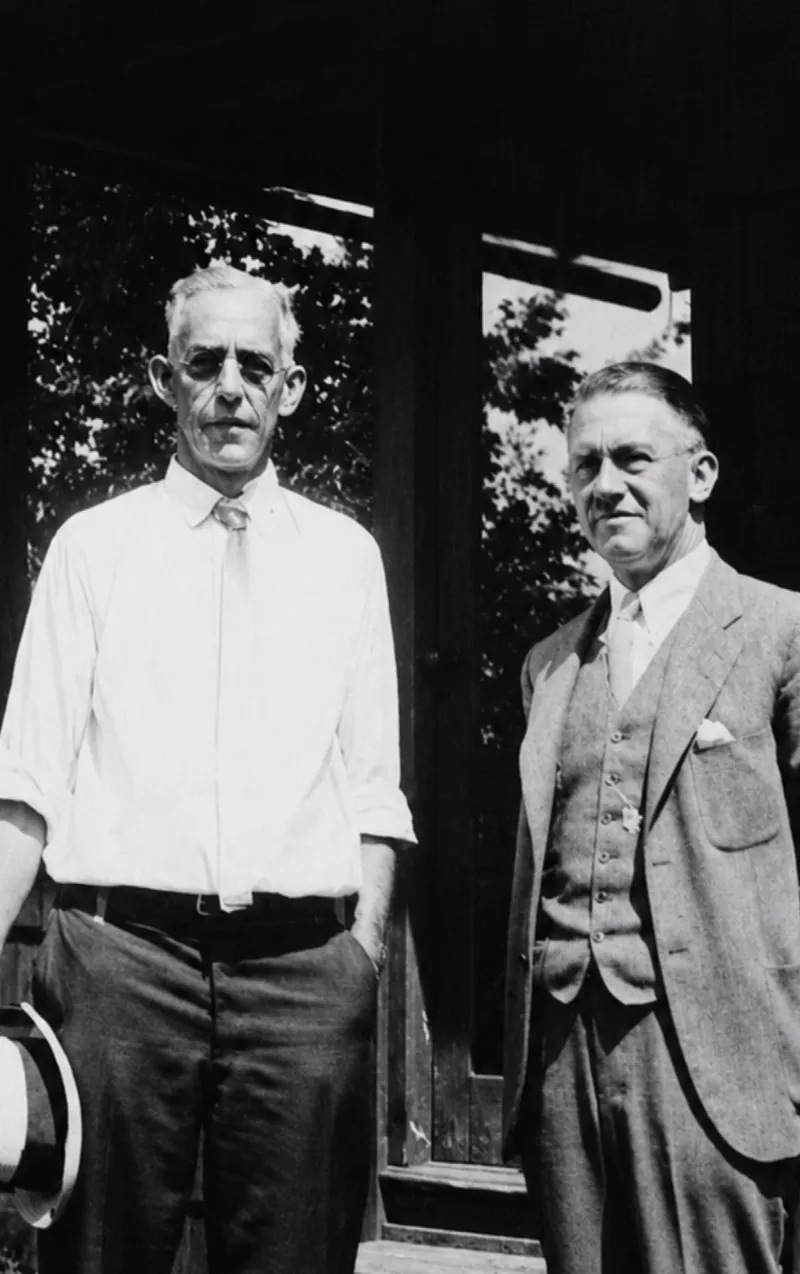
    Dr. Samuel T. Orton and Peter Gow, Jr. standing side by side outdoors in 1929, Orton in shirtsleeves holding a hat and Gow in a three-piece suit
    Dr. Samuel T. Orton and Peter Gow, Jr., 1929

    Adapted from "The Patterns Behind Progress" by Dr. Mari Jo Renick, Director of Research and Assessment at The Gow School.

    At a Glance

    • 1927: Peter Gow, Jr. and Dr. Orton begin twenty years of work together
    • Reading assessed at the admissions visit and again every spring
    • Reading profiles of 906 students studied since 2000

    Then: One Student's Profile

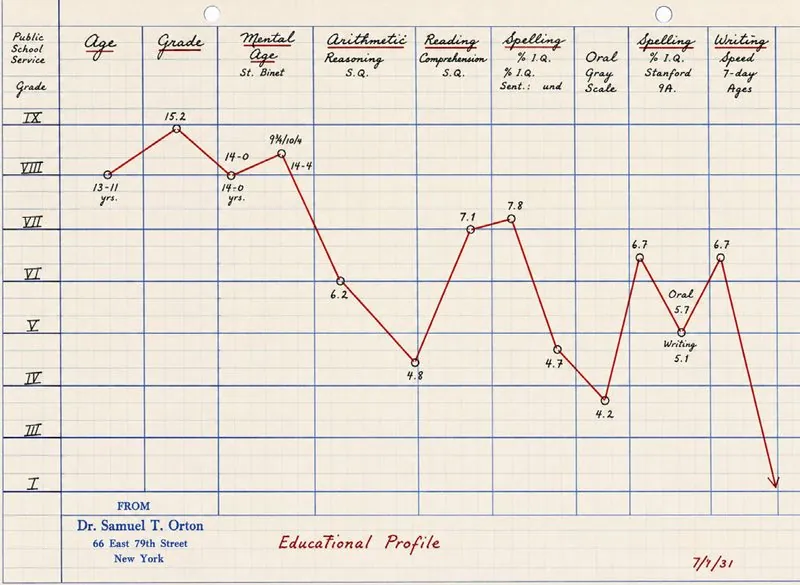
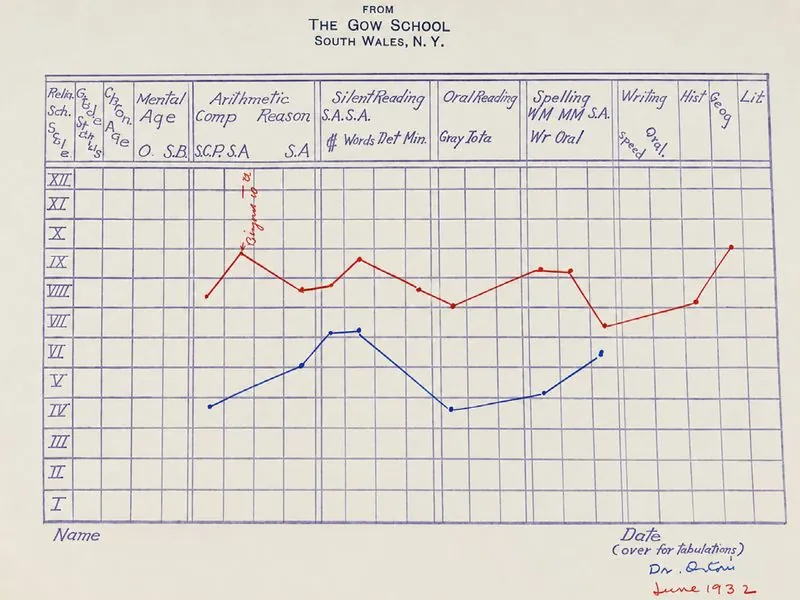
    These two charts follow the same student. The first is Dr. Orton's testing from July 1931, before he referred the student to Gow. The second came after one school year at Gow.

    Each chart plots a student's level skill by skill: reasoning, reading, spelling, writing, and more. Seen this way, a student's strengths and gaps stand out at a glance, along with how they shift over a year.

    Hand-drawn Educational Profile from Dr. Samuel T. Orton, dated July 1931: a red line plots one student's results by grade level across age, mental age, arithmetic, reading, spelling, oral reading and writing speed, rising and falling sharply from skill to skill
    Testing scores from July 1931, for a student Dr. Samuel T. Orton referred to The Gow School.
    Hand-drawn testing chart on The Gow School, South Wales, N.Y. letterhead, with a blue line and a red line plotting the same student's results across mental age, arithmetic, silent and oral reading, spelling, writing and other subjects
    The same student after one school year at Gow. The red line is Gow's testing from June 1932.

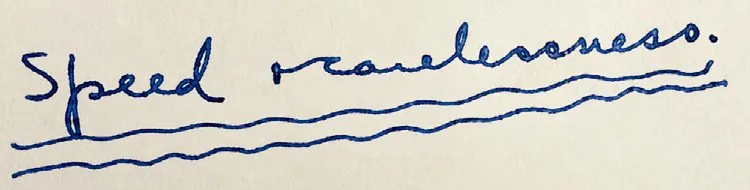
    From the archives. Early records did more than report scores. A handwritten comment, "speed + carelessness," reads a student's reading as a profile: quick, but less accurate. Gow's educators still study that pattern today, now with decades of data. As the next section shows, it is still common among students who come to Gow.

    Handwritten note in blue ink reading "Speed + carelessness," underlined twice

    Now: From Profiles to Pathways

    Just as in the days of Peter Gow, Jr. and Dr. Orton, data on each student's skills gives us a starting point, shapes teaching, and shows growth over time.

    We assess literacy skills during a student's admissions visit and again each spring. So far, the data on more than 900 students tested at admissions since 2000 have been digitized, and earlier records are still being entered.

    How Students Read When They Arrive

    Students come to Gow with different reading profiles. We compare two things: reading rate, or how quickly a student reads, and accuracy, or how correctly they identify words.

    • Rate ahead of accuracy: 253 students (28%). They read faster than they identified words accurately, the same pattern noted in the hand-drawn records.
    • Balanced: 541 students (60%). Reading rate was about even with accuracy.
    • Accuracy ahead of rate: 112 students (12%). They read slowly, but more accurately.

    Reading profiles at admissions, 2000 to the present, for 906 students.

    Two Pathways from the Same Start

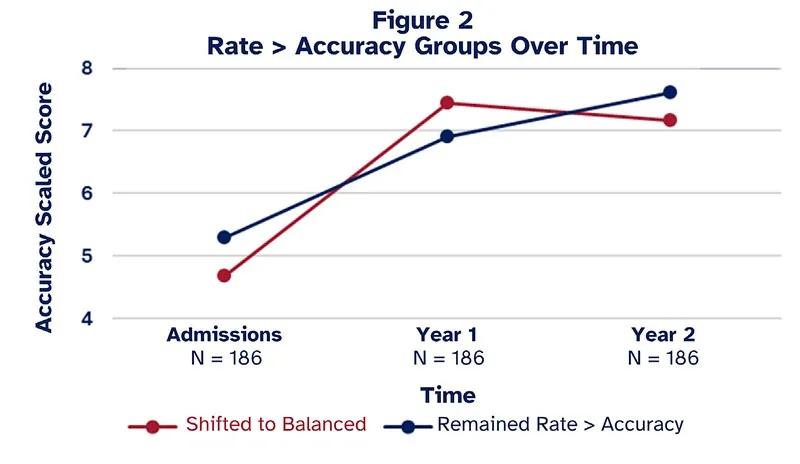
    We then followed 186 students who arrived reading faster than they read accurately, and measured their accuracy at admissions, after Year 1, and after Year 2. By Year 1, the group had split in two.

    • Shifted to BalancedThe gap between rate and accuracy narrowed.
    Line chart of accuracy scaled scores at admissions, Year 1 and Year 2, for students who began with reading rate ahead of accuracy. The group that shifted to balanced starts lowest at admissions and rises most steeply by Year 1. The group that stayed rate ahead of accuracy rises more gradually and is highest by Year 2. Both groups score higher at Year 2 than at admissions.
    Accuracy scores at admissions, Year 1, and Year 2 for the 186 students who arrived reading faster than they read accurately.

    Accuracy rose in both groups between admissions and Year 2. Knowing which pathway a student is on tells their teachers where to focus next.

    What This Means for Your Child

    Your child's reading is assessed at the admissions visit and again each spring. Teachers see the pattern behind the score, and teach to it.

    How The Gow Method Works

    What's Next

    As Gow enters its second century, our data grows every year. It gives us new ways to take up Peter Gow, Jr.'s original question.

    "…this puzzling phenomenon…that students learn[ed] the same things in different ways, through different channels."David W. Gow, A Father, a Son, a School (2002)

    For your child, that means a school that keeps asking how they learn, and keeps checking that the answer is working.

    Privacy Policy

    Use of Personal Information

    We do not collect any personal information unless you voluntarily provide it by sending us e-mail, participating in a survey, or completing an on-line form. Personal information submitted will not be transferred to any non-affiliated third parties unless otherwise stated at the time of collection. When a user submits personally identifiable information it is used only for the purpose stated at the time of collection.

    Consent

    Where consent for the use and disclosure of personal information is required, the school will seek consent from the appropriate person. In the case of a student’s personal information, the school will seek the consent from the student and/ or parent depending on the circumstances and the student’s mental ability and maturity to understand the consequences of the proposed use and disclosure.

    Cookies

    A cookie is a small text file stored by your browser that allows the website to “remember” your preferences (such as calendar settings and site bookmarks) on the site from visit to visit, or to maintain your “logged in” status when visiting protected areas . Usage of a cookie is in no way linked to any personally identifiable information while on our site. Web browsers have settings allowing you to reject cookies, or selectively accept cookies, or delete cookies previously accepted. Please be aware that rejecting or deleting cookies from our website may make certain functions unavailable to you.

    Log Files

    Like most standard website servers we use website statistic packages such as Google Analytics to analyze trends in how our website is accessed and utilized. Information monitored includes internet protocol (IP) addresses, geographic location of visitors (country, city), browser type, internet service provider (ISP), referring/exit pages, platform type, date/time stamp, time spent on pages, and keywords used to find our site via search engines. This information is anonymous and cannot be directly linked to individual users. We may use it to identify high-use or low-use areas of the site, pinpoint problem areas of the site, analyze broad demographic trends in our visitors, and make decisions about how to make it easier for people to find and navigate our website.

    Links

    This website may contain links to other sites. Please be aware that we are not responsible for the privacy practices of such other sites. We encourage our users to be aware when they leave our site and to read the privacy statements of each and every Web site that collects personally identifiable information. This privacy statement applies solely to information collected by this website.

    Security

    This website takes every precaution to protect our users' personal information. Whenever users submit personal information (such as contact info or credit card info) via online forms, registration, or online purchase, upon submission that information is encrypted via the highest level of SSL (Secured Sockets Layer) available. Servers that store personally identifiable information are in a secure environment. Under no circumstances are credit card numbers permanently stored on our website servers.

    Non-Secured Communications

    Posts to discussion forums, discussion boards, comments to blogs, and Alumni Class Notes are viewable by other users. When these areas are not in a password protected area, they may be viewable by the general public. Please be aware of this when posting personal information in these areas.

    Contact Information

    If users have any questions or suggestions regarding our privacy policy, please contact us.

    Non-Discrimination Policy

    The Gow School admits students of any race/color, ancestry/national origin, religion/creed, and sexual orientation to all the rights, privileges, programs, and activities generally accorded or made available to students at the school. It does not discriminate on the basis of race/color, ancestry/national origin, religion/creed, and sexual orientation in the administration of its educational policies, admission policies, scholarship and loan programs, athletic, and other school-administered programs.

    The Gow School is an Equal Opportunity Employer. We do not discriminate on the basis of race/color, ancestry/national origin, religion/creed, gender, sexual orientation, marital status, age, or disability. The Gow School complies with Federal and State Laws regarding nondiscrimination and preference.

    Land Acknowledgement Statement

    The Gow School acknowledges that our campus is situated on the land once belonging to the Haudenosaunee people and we pledge to honor their enduring presence.